


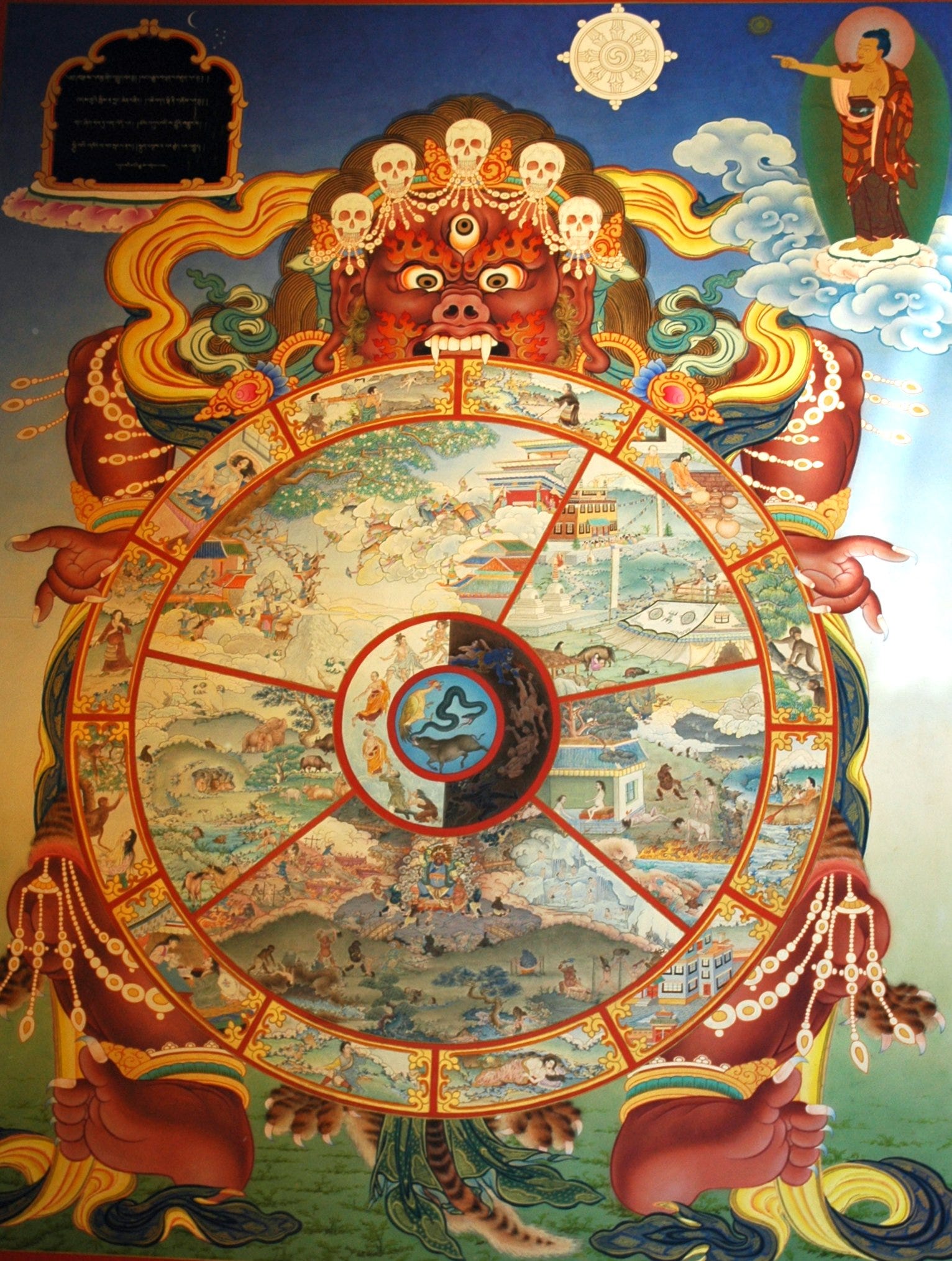
Saṃsāra
Of the infinite number of human views, concepts and beliefs, one seems particularly intriguing to me. Namely, that of reincarnation. H.P. Lovecraft once wrote: "The oldest and strongest emotion known to mankind is fear, and the oldest and strongest kind of fear is fear of the unknown".
The fear of death is certainly the fear of something unknown to the living. So to tame it, beliefs and religions have been invented. One such belief is the belief in reincarnation. But is this concept in any way more sensible than other beliefs?
Reincarnation or transmigration is the view or belief that the soul or consciousness can reincarnate into a new physical entity after the death of the body. It is a very old belief, known to people as far back as antiquity. In ancient Greece, for example, reincarnation was believed in by Pythagoras. Ovid writes about the wanderings of Pythagoras' soul in Metamorphoses, I, XV.
In Europe, it was also known by the Celtic Druids, for example. The Jewish Kabbalah also teaches about the transmigration of souls.
This is also a view that was known in ancient times in Europe and Asia alike.
Although this view was old and widespread, it did not appeal to the founders of Christianity. One of the anonymous founders of this religion decided to deny reincarnation, writing: “Just as men must die once, and then judgment follows” - Hebrews 9: 27
And one of the later so-called church fathers, Origen, wrote on the subject of reincarnation in his commentary on the Gospel of Matthew as follows: "...Here it does not seem to me that Elijah speaks of the soul, and that I should fall into the dogma of transmigration, which is foreign to the Church of God and was not handed down by the Apostles, nor mentioned anywhere in Scripture...".
Instead, the teaching of preexistence (the existence of the soul before conception) was condemned by the Council of Constantinople II (553). Reincarnation is therefore an anti-Christian view.
Belief in the judgement of a vengeful god and punishment in eternal fire was apparently cooler for Christians.
The concept of reincarnation is most prevalent and occurs in its most elaborate form in Asian countries.
In India, Hinduism teaches that the soul participates in an eternal cycle of life and death and reincarnation until it is interrupted, that is, incarnations cease when full enlightenment is achieved. Which entity the soul incarnates into at rebirth is determined by karma. Through good deeds it is possible to reincarnate in a future life into a better entity, while through bad deeds it is possible to reincarnate into an inferior entity, such as an animal or a plant.
A slightly different view of reincarnation is found in Buddhism, which does not believe in an eternal soul passing on to the next life.
"To claim that at death, along with the life of the body, the mental life also ends is one extreme. The other is the view that any psychic element, such as the immortal soul, has the capacity to survive death unchanged. Buddhism, as everywhere else, takes the middle path here, teaching that the 'essence' of one life is neither exactly the same nor completely different from the 'essence' of the next life. Although Buddhism has acceded to the term 'rebirth', it excludes the possibility of misinterpretation by emphasising that there is no one who has been reborn."
- Bhikshu Sangharakshita -
In Buddhist teaching on reincarnation, there is the concept of Saṃsāra.
Saṃsāra - "It is an endless (painful, suffering-filled) repetitive cycle of birth and death, wandering from one life to another with no definite direction or purpose".
The Buddhist doctrine of Anatta, or no-soul (no-self), holds that there is no immortal soul in the eternal cycle of rebirth, which it migrates from body to body.
Apart from religious and spiritual versions of reincarnation, in the real world there is a purely materialistic and biological process of specific reincarnation called inheritance. In animals such as humans, for example, inheritance involves the fusion of two gametes - a male and a female - at the moment of fertilisation. Each contains chromosomes, which carry genetic information. What a person will be like is written in the DNA and this is passed on to them through the process of inheritance. A person inherits not only physical characteristics, but also levels of intelligence, personality traits, and may also inherit mental illnesses, and, according to the latest scientific research, also knowledge, which is part of consciousness. Thus, it can be assumed that in addition to corporeality, the consciousness of previous entities is also transmitted to him in a completely soulless way (having nothing to do with the existence of some eternal soul).

The above illustration shows an old Slavic religious symbol -Kolovrat. The kolovrat represents the endless cycle of birth and deaths, time, the sun and fire, strength and dignity. Each turn of the wheel is a cycle of life in our world.
Ecclesia Luciferi preaches the doctrine of a kind of godless reincarnation, or rather a soulless, materialistic carry-over. It is both an anti-religious and materialistic view of biological reincarnation, according to which each entity passes on its previous life to the next entity physically born from it. Each new entity is born perfectly godless and sinfully imperfect to live in a world completely indifferent to it. The natural godlessness attributed to Luciferian rebellion is passed on to the next generation in genes, in an eternal cycle of birth and death. Life is eternal in this cycle as long as it is passed on, until the eternal cycle is broken, at which point eternal death occurs.
In spiritual terms, on the other hand, the concept of godless reincarnation according to Ecclesia Luciferi is closest to the Buddhist concept of saṃsāra, which is 'a suffering-filled, continuous cycle of life, death and rebirth, without beginning or end'.
And although the immortal soul does not exist, there is a kind of 'carryover' of the godless or sinful and soulless consciousness in the process of inheritance. In this way, a kind of immortality is possible until the eternal cycle is broken. Then eternal death occurs.
In my book The Satanic Kerygma, I write on this subject as follows:
“The Satanist, who identifies with the eternal cycle of death and rebirth of the sinful nature, sees death as a transition to its eternity .
Death ends the opportunity for abundant life and the chance to consciously accept or reject the ungodly gifts of the fallen nature. Every human being receives immediately after death the gift of eternity in nothingness or the gift of the eternity of the cycle of the mortal nature, an ungodly life handed down for inheritance to the next generation, an ungodly reincarnation whose final end will take place with the end of the cycle of life itself.
To accept life in the eternal cycle of the sinful nature means to accept the Luciferian order of things. Satanists live abundantly because they have grasped what the Luciferian order of the eternal universe really is, they find their true identity in it.
To live is to embrace Lucifer's sin; where there is sin, there is life abundant and the kingdom of godlessness .
Lucifer has shown us sinful freedom through his rebellion. The life of the ungodly consists in the full possession of the fruits of flesh and blood by Satanic self-consciousness, which includes in its ungodly glory those who have discovered it and identified themselves with its will. Earthly pleasures are available to those perfectly united with the Luciferian consciousness of the natural world.
The ecstasy of the instincts in those perfectly united with the Luciferian order of nature sometimes exceeds the possibilities of conscious understanding and imagination. This must be experienced. To paraphrase a Christian preacher: "...the heart of man has failed to comprehend how great things Satan has prepared for those who manage to understand him".
Hail Lucifer.
LCFNS MMXXIII

To me it is easier to accept that brain death is the termination of the human animal. My own subjective consciousness is not passed down to my children. Granted, they have the indelible (not to say untreatable) inheritance of my and my spouse’s DNA, for good or ill.
But any sense of individual reincarnation, even on the cellular level, does not appear to be in line in with a real grasp of the anti-cosmic Satanic perspective. I would even go so far as to add that any conception of an afterlife that has its origin in human subjectivity is ipso facto false.
While there are certain laws of nature that appear to apply in all circumstances, humans have the deeply troubling and ultimately endless ability to interpret those laws according to cultural and personal whim. It also seems that “objectivity” itself is merely the convergence of multiple subjective entities. This is hardly a criterion for “truth”.
At this point I’ve been epistemologically reduced to incomprehensible paradox. This, however, is good. Because Satan (and Odin) are gods of Chaos. This Chaos is where the multiverse began and into which it will ultimately collapse.
In the world we have travail, but take heart! The void has overcome all being. Dead world without end.